A city of contrasts in eastern Poland, on the River Bystrzyca. The western part is characterised by beautiful ravines, valleys and hills, while the eastern part consists of plains. Read on to find out more!
Lublin, the capital of Lublin Province, is a city whose history dates back to the 6th century, when a settlement existed on Czwartek Hill. The first written mention of the city dates from 1198.
What should you see when visiting Lublin?
1. Crown Tribunal – the former Town Hall and once the highest court of the Crown of the Kingdom of Poland in the Polish–Lithuanian Commonwealth. The first wooden town hall burned down in 1389, after which the Crown Tribunal was built.
2. Gothic Tower – a surviving reminder of the city's Gothic defensive walls.
3. Kraków Gate – a historic symbol of the city, built in the 14th century to guard access to the Old Town. In the 18th century, the building was remodelled in the Baroque style. Krakowskie Przedmieście, Lublin's main thoroughfare, begins at Kraków Gate. A walk along it starts at Łokietek Square, opposite the New Town Hall, which was built in the 19th century on the ruins of a Carmelite monastery. Next to the Town Hall stands the Church of the Holy Spirit, whose history dates back to the 15th century. Continuing along Krakowskie Przedmieście, you will reach Lithuanian Square, where King Sigismund II Augustus accepted the feudal homage of the Grand Master of the Teutonic Order. Here you will find fountains and the Union of Lublin Monument, while the 17th-century Czartoryski Palace stands on the opposite side of the square.
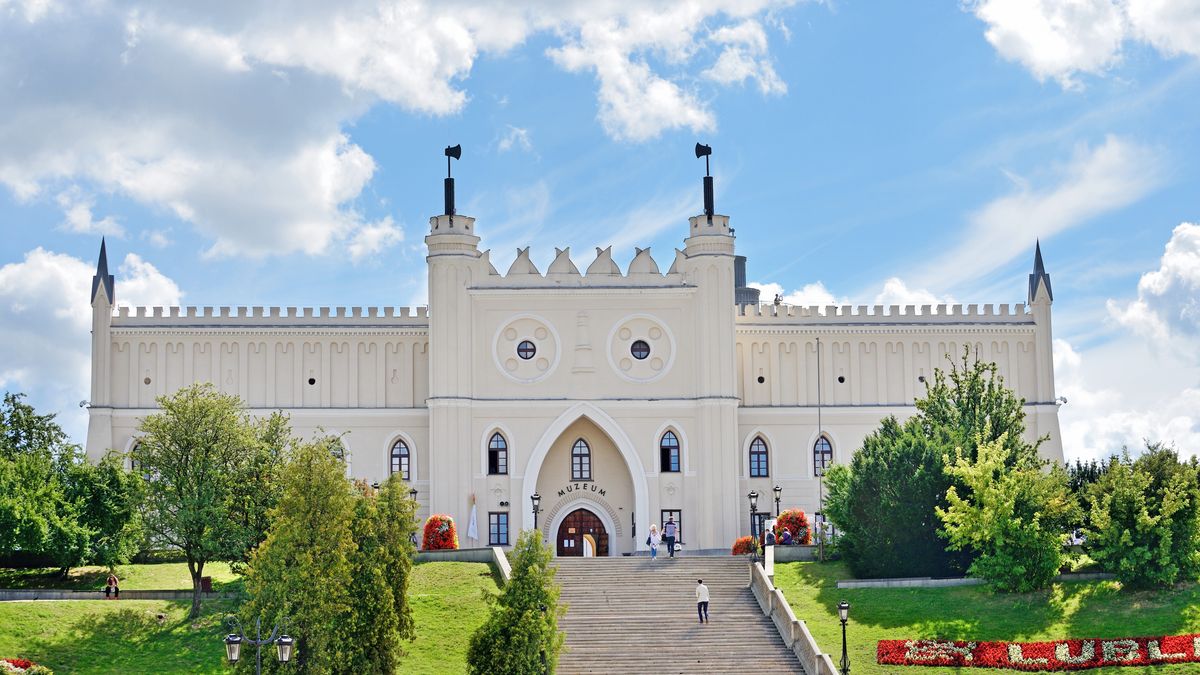
4. Lublin Castle – built in the 12th century during the reign of Casimir the Great. A keep was added in the 13th century, followed in the 14th century by the Chapel of the Holy Trinity, which is decorated with Ruthenian-Byzantine frescoes dating from 1418. The castle also housed a prison until 1954, and since 1957 it has been home to the National Museum.
5. St Nicholas's Church – located on Czwartek Hill, it was built in the 16th century. Kajetan Szeptycki, Castellan of Lublin, is buried in the church crypt.
6. The Keep – the first masonry structure on the hill, this round defensive tower dates from the 12th century. A viewing platform at the top offers beautiful panoramic views.
7. Gallery of Polish Painting – a must-see in Lublin thanks to its rich collection of works by outstanding Polish artists, including paintings by Jan Matejko, Stanisław Wyspiański and Jacek Malczewski.
8. Saxon Garden – established in the 19th century, the garden offers more than 15 hectares of greenery, peace and tranquillity. Hills, a peacock aviary and a pond add to its charm, and the grounds also include an amphitheatre. Designed in the English landscape style and opened in 1837, the Saxon Garden is one of the oldest public urban parks in Poland.
As you can see, Lublin is a city full of historic landmarks—far too many to list them all. There is certainly something here for everyone. It is worth spending a few days in the city to discover its many charms, but even a few hours can be enough to spark an interest in Lublin and make you want to plan a return visit.