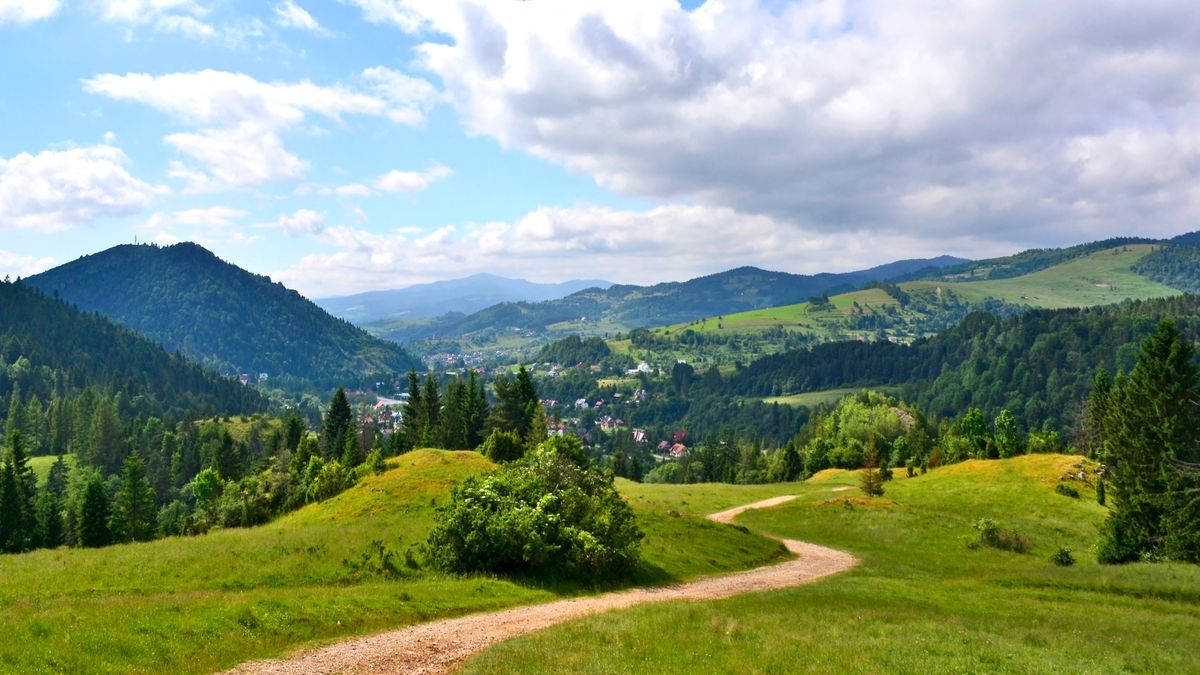
Szczawnica lies in the Grajcarek Valley, surrounded by the Beskid Sądecki and Little Pieniny mountain ranges.
It is a spa town that began to develop in 1839 thanks to Józef and Anna Szalay. The earliest records of the town date from 1413. Szczawnica expanded rapidly during the 1960s.
Historic landmarks in Szczawnica:
‘Inhalatorium’ Sanatorium - built between 1934 and 1936 by Count Adam Stadnicki. It stands on the site of the former ‘Castle’, one of the oldest spa houses in Poland. Today, the sanatorium impresses visitors with its beautiful historic architecture.
Waleria Spring is a historic mineral-water spring intake near Dietl Square in Szczawnica. The spring has not been used since 1945 because of contamination, but the site remains worth visiting. Discovered in 1840, the spring was initially surrounded by a Romantic-style grotto. In 1867, the grotto was replaced by an iron pavilion. A platform was later built above it, where an orchestra entertained spa visitors.
The Chapel of Our Lady of Częstochowa is a historic chapel in Szczawnica’s Lower Park. The building erected there between 1867 and 1876 originally served as a mineral-water pump room. In 1873, the pump room was converted into a chapel, and the first Mass was celebrated there on 6 July 1877.
Szalay Manor was built in 1839 in the neoclassical style for the Szalay family. It was commissioned by Józef Szalay, a Hungarian nobleman and the founder of the spa. Once known as the ‘Pavilion’, it was never permanently occupied. The Szalay family used it mainly as a place to receive guests.
Dworek Gościnny (Guest Manor) is now a theatre and hotel complex in Szczawnica. The building has a long history dating back to the 19th century and officially opened in 1884. It was an impressive structure, built from larch wood, covered with shingles and decorated with numerous galleries, porches, dormer windows and turrets. Unfortunately, the original building was completely destroyed by fire in 1962. Rebuilding it was not possible for many years. In 2008, after Count Stadnicki’s relatives recovered the property, reconstruction began and the building’s original form was recreated.
Church of St Adalbert - the present church was built between 1882 and 1892. Its interior is neo-Gothic and dates from the turn of the 20th century. Visitors should pay particular attention to the main altar, which was completed in 1892. Interestingly, the attic is home to lesser horseshoe bats, a very rare species.
Besides its historic landmarks, Szczawnica offers other attractions, including a chairlift that carries visitors up Palenica. For active travellers, there are around 4 kilometres of ski runs. Five hiking trails pass through Szczawnica: one red, two blue, one yellow and one green.
Szczawnica is an ideal destination for anyone who wants to enjoy the mountains while staying active. It makes a perfect base for mountain trips in both winter and summer. Everyone will find something to enjoy.